
Give Me a Number
When your mother insists everything is a 10, and you’re just trying to fill out the paperwork.

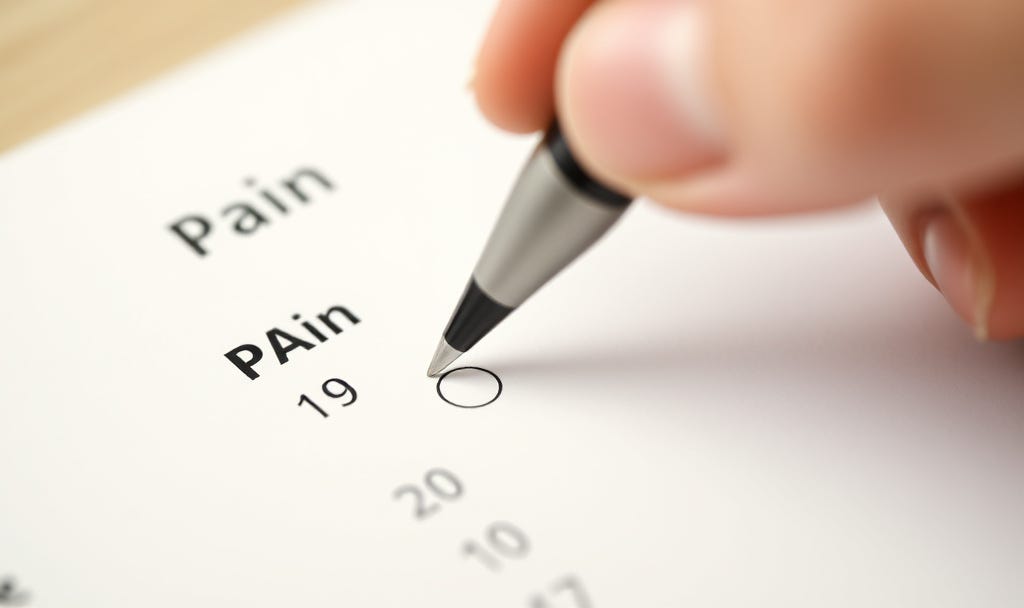
“On a scale of 1 to 10, how much pain are you in today?” I ask Mom.
“Ten,” she replies.
“On a scale of 1 to 10, how much is the pain interfering with your day-to-day life?”
“Ten.”
“On a scale of 1 to 10, how much worse would you categorize the pain from your prior visit?”
“Ten.”
I sigh and lower the clipboard to look at her.
We are sitting in the waiting room at some doctor’s office. At this point, I can’t keep track of which one. They all tend to blend into one another with their mint-colored walls. I suspect they think this is a step up from beige. They are wrong. There is furniture circled like wagons and shoved up against every available wall. A mandatory fake decorative plant and a People magazine from 2017 with Julia Roberts declared The World’s Most Beautiful Woman.
Some things never change.
There is a water fountain with a stream that barely bubbles past the lid, which you couldn’t pay me to drink from, and a receptionist beyond a smudged, possibly bulletproof, pane of glass.
The one thing I can count on at every office are the pre-visit questionnaires asking patients to rate their pain.
I have yet to see a doctor actually read or refer to one of these sheets during an appointment. Of course, that could very well be because my mother insists she is at the top of the pain scale for everything.
It’s kind of like how, at work, when everything is an emergency, nothing is.
I suspect Sandy declaring herself a “10” across the board is having the same effect on her physicians. Especially when she comes teetering into the room, smiling and accepting compliments on her hair.
“Mom, you can’t answer 10 for every question,” I say. “You told me this morning, when I picked you up, that your back has felt a little better this week. Wouldn’t that at least merit a nine?”
She sniffs.
“Okay. You can put nine.”
I have never cheated on or failed a quiz in my life, and I’m not about to start now.
“I don’t want to just put down a random number,” I say. “Let’s give them an accurate description of your pain level. So this question about interfering with your daily activities. What have you not been able to do?”
“I can barely leave my room.”
Readers, you’ve been along this ride with me long enough to guess my response.
My mom could be transported into the body of a sixteen-year-old Olympic athlete who nailed the landing off the high bars and she still would find a reason not to leave her room.
What I’m trying to figure out is how much her back is actually hurting, regardless of whether or not she has set foot in the hallway.
“You had your physical therapy sessions this week, right?” I ask. “So you were able to do those.”
She loves Liz, her physical therapist, probably because Liz gives her undivided attention for 90 minutes twice a week. I love Liz for the exact same reason.
“Yes, I saw Liz twice. We had so much fun.”
“What about bathing? Were you able to shower this week?”
“Oh yes, yes.”
I wonder if she sees where I’m going with this.
“So…it sounds like even though your back hurts, you were still able to do most of your normal routines.”
“Fine. Just put down three,” she snaps.
Yes. She saw where I was going with it.
I spend the next few minutes before we’re called back cajoling her into trying to come up with a realistic number. Not the number that sounds the most dramatic. Not the number that proves she is suffering. Just a number that might actually tell the doctor something useful.
I think we rock, paper, scissored our way to a “7+.”
Which, for the record, I don’t believe is technically an option.
The killer questionnaire is the mental wellness quiz at her general practioner where, instead of physical pain, you’re asked to rate how anxious or depressed you’ve been over the past few days, weeks, or months.
Mom and I both laugh when I hand it to her.
“Just circle 10 for everything,” she says.
“I refuse to be responsible for them putting you on 24-hour suicide watch,” I tease. “Just answer as best you can.”
She has trouble seeing, so I read the questions aloud.
“How much has your anxiety or depression interfered with your day-to-day life?”
She looks at me.
I look back.
“What do you think?” she asks.
“I think only you can answer this.”
“Do you think I should put nine?”
“There is no wrong answer. I think you should put whatever feels right for you.”
She looks back down at the paper.
And right about now is where it stops being funny.
I can argue with her about whether she is a seven or a nine for back pain. I can interrogate her about whether she showered or went to physical therapy. I can point out that someone who has spent 90 minutes with Liz twice this week probably has not been completely incapacitated.
But I can’t tell her how anxious or depressed she is. I can’t even tell her how much those things have interfered with her life.
That number belongs to her.
That’s what makes these questionnaires so maddening. They ask for a precise answer to something that is almost impossible to measure. And yet, here we sit, every few weeks, trying to squeeze my mother’s entire experience into a series of little circles.
Eventually, I drop her off and drive home.
I’m so tired I walk into the house, drop my things somewhere I’ll regret later, and collapse face-down on the couch.
Mike finds me there.
“Another rough one?” he asks.
I don’t bother lifting my head.
“On a scale of 1 to 10,” I tell him, “mark me down for an 11.”
Wow, you stuck that landing. 💪
Thought you would appreciate my magnet at work 😂